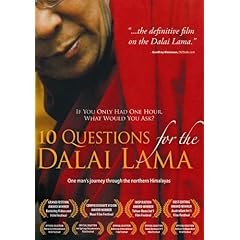
10 Questions for the Dalai Lama


Review
4 Stars. Editor's Choice. Highly Recommended. A tender, moving commentary on compassion, tolerance, and finding the middleway through moral dialogue within the global community, 10 Questions for the Dalai Lama is a surprisingly humorous, thought-provoking, and uplifting film. --Video Librarian
Everyone should watch this movie. A perfect blend of history, drama, artful presentation, and profound inspiration. --New Age Retailer
The Boston Globe
"One comes away from "10 Questions" emboldened, energized, and sadder -- aware that peace remains so radical a concept that most of us aren't yet worthy of it."
Minneapolis StarTribune
"3 out of 4 Stars. Enlightenment rarely sounds so practical and levelheaded."
About the Actor
HIS HOLINESS THE 14TH THE DALAI LAMA TENZIN GYATSO, is the head of state and spiritual leader of the Tibetan people. He was born Lhamo Dhondrub on 6 July 1935, in a small village called Taktser in northeastern Tibet. Born to a peasant family, His Holiness was recognized at the age of two, in accordance with Tibetan tradition, as the reincarnation of his predecessor the 13th Dalai Lama, and thus an incarnation Avalokitesvara, the Buddha of Compassion. The Dalai Lamas are the manifestations of the Bodhisattva (Buddha) of Compassion, who chose to reincarnate to serve the people. Lhamo Dhondrub was, as Dalai Lama, renamed Jetsun Jamphel Ngawang Lobsang Yeshe Tenzin Gyatso - Holy Lord, Gentle Glory, Compassionate, Defender of the Faith, Ocean of Wisdom. Tibetans normally refer to His Holiness as Yeshe Norbu, the Wishfulfilling Gem or simply Kundun - The Presence.
The Norwegian Nobel Committee's decision to award the 1989 Peace Prize to His Holiness the Dalai Lama won worldwide praise and applause, with exception of China. The Committee s citation read, The Committee wants to emphasize the fact that the Dalai Lama in his struggle for the liberation of Tibet consistently has opposed the use of violence. He has instead advocated peaceful solutions based upon tolerance and mutual
respect in order to preserve the historical and cultural heritage of his people. His Holiness often says, I am just a simple Buddhist monk - no more, nor less.
His Holiness follows the life of Buddhist monk. Living in a small cottage in Dharamsala, he rises at 4 A.M. to meditate, pursues an ongoing schedule of administrative meetings, private audiences and religious teachings and ceremonies. He concludes each day with further prayer before retiring. In explaining his greatest sources of inspiration, he often cites a favorite verse, found in the writings of the renowned eighth century Buddhist saint Shantideva:
For as long as space endures
And for as long as living beings remain,
Until then may I too abide
To dispel the misery of the world.
About the Director
Cinematographer, writer and director Rick Ray has traveled the world to capture images of its peoples and cultures. He has produced twelve films on regions as diverse as Israel, Bali, Borneo, Lebanon, Ethiopia, Syria, and Iceland, with titles that include Raise the Bamboo Curtain with Martin Sheen and the highly regarded The Soul of India. Beyond trips to India to acquire footage for the film, Ray spent 2 years tracking down rare archival footage of the Dalai Lama's youth, the Chinese takeover, and subsequent hardships. Ray feels honored to have had the opportunity to interview the Dalai Lama and bring the experience to the screen.
Product Description
How do you reconcile a commitment to non-violence when faced with violence? Why do the poor often seem happier than the rich? Must a society lose its traditions in order to move into the future? These are some of the questions posed to His Holiness the Dalai Lama by filmmaker and explorer Rick Ray. Ray examines some of the fundamental questions of our time by weaving together observations from his own journeys throughout India and the Middle East, and the wisdom of an extraordinary spiritual leader. This is his story, as told and filmed by Rick Ray during a private visit to his monastery in Dharamsala, India over the course of several months. Also included is rare historical footage as well as footage supplied by individuals who at great personal risk, filmed with hidden cameras within Tibet. Part biography, part philosophy, part adventure and part politics, "10 Questions for The Dalai Lama" conveys more than history and more than answers - it opens a window into the heart of an inspiring man. If you had only one hour, what would you ask?
