In 1998's Elizabeth, Shekhar Kapur added a layer of suds to his history lesson; the director follows the same audience-pleasing recipe in Elizabeth: The Golden Age. Since the first film, Blanchett scored an Oscar for her note-perfect rendition of Katharine Hepburn in The Aviator, and she plays the preternaturally bemused monarch in a similar fashion. By 1585, Elizabeth I is an experienced ruler about to face two of her biggest challenges: betrayal by her Catholic cousin, Mary Stuart (Control's Samantha Morton), and invasion by the Spanish Armada. It isn't so much that the Protestant Elizabeth wishes to rid England of "papists," but that she wants her country to remain free from foreign domination. Closer to her home, she enjoys a sisterly relationship with lady-in-waiting Bess (rising Aussie star Abbie Cornish). That changes when Sir Walter Raleigh (a dashing Clive Owen) hits the scene. In order to continue exploring the New World, he seeks the queen’s sponsorship. She is charmed, but Raleigh only has eyes for Bess. As in the previous picture, Elizabeth enjoys better luck at affairs of state than affairs of the heart, but the conclusion is more beatific than before (and Kapur intends a third installment if Blanchett is willing). Elizabeth: The Golden Age is a rush of royal intrigue, bloody torture, fantastic headpieces, and irresistibly ripe dialogue, like "I have a hurricane in me that will strip Spain bare if you dare to try me!" To Kapur, victory for the Virgin Queen was a viable alternative to sex. --Kathleen C. Fennessy
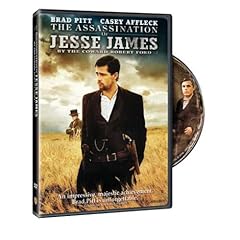
Of all the movies made about or glancingly involving the 19th-century outlaw Jesse Woodson James, The Assassination of Jesse James by the Coward Robert Ford is the most reflective, most ambitious, most intricately fascinating, and indisputably most beautiful. Based on the novel of the same name by Ron Hansen, it picks up James late in his career, a few hours before his final train robbery, then covers the slow catastrophe of the gang's breakup over the next seven months even as the boss himself settles into an approximation of genteel retirement. But in another sense all of the movie is later than that. The very title assumes the audience's familiarity with James as a figure out of history and legend, and our awareness that he was--will be--murdered in his parlor one quiet afternoon by a backshooting crony.
The film--only the second to be made by New Zealand–born writer-director Andrew Dominik--reminds us that Dominik's debut film, Chopper (2000), was the cunningly off-kilter portrait of another real-life criminal psychopath who became a kind of rock star to his society. The Jesse James of this telling is no Robin Hood robbing the rich to give to the poor, and that train robbery we witness is punctuated by acts of gratuitous brutality, not gallantry. Nineteen-year-old Bob Ford (Casey Affleck) seeks to join the James gang out of hero worship stoked by the dime novels he secretes under his bed, but his glam hero (Brad Pitt) is a monster who takes private glee in infecting his accomplices with his own paranoia, then murdering them for it. In the careful orchestration of James's final moments, there's even a hint that he takes satisfaction in his own demise.
Affleck and Pitt (who co-produced with Ridley Scott, among others) are mesmerizing in the title roles, but the movie is enriched by an exceptional supporting cast: Sam Shepard as Jesse's older, more stable brother Frank; Sam Rockwell as Bob Ford's own brother Charlie, whose post-assassination descent into madness is astonishing to behold; Paul Schneider, Garret Dillahunt, and Jeremy Renner as three variously doomed gang members; and Mary-Louise Parker, who as Jesse's wife Zee has few lines yet manages with looks and body language to invoke a wellnigh-novelistic backstory for herself. There are also electrifying cameos by James Carville, doing solid actorly work as the governor of Missouri; Ted Levine, as a lawman of antic spirit; and Nick Cave, composer of the film's score (with Warren Ellis) and screenwriter of the Aussie "Western" The Proposition, suddenly towering over a late scene to perform the folk song that set the terms for the book and movie's title.
Still, the real costar is Roger Deakins, probably the finest cinematographer at work today. The landscapes of the movie (mostly in Alberta and Manitoba) will linger in the memory as long as the distinctive faces, and we seem to feel the sting of its snows on our cheeks. Interior scenes are equally persuasive. Few Westerns have conveyed so tangibly the bleakness and austerity of the spaces people of the frontier called home, and sought in vain to warm with human spirit. --Richard T. Jameson
Set in America during the Vietnam War, Across the Universe is a powerful love story set against a backdrop of political and social unrest: it's a story of soul-searching, self-doubt, and individual powerlessness cleverly conveyed through a multitude of Beatles songs. Like young adults all across America during the 1960's, Jude (Jim Sturgess), Lucy (Evan Rachel Wood), Max (Joe Anderson), Sadie (Dana Fuchs), Prudence (T.V. Carpio), and JoJo (Martin Luther) are in turmoil over the war; questioning their individual roles in the war effort and struggling to find a way to hold true to their beliefs while making a difference in the world. While love proves a powerful uniting force, its limitations become clear as relationships are strained and broken over individual perceptions of responsibility to cause and country. A fairly bizarre juxtaposition of extremely stylized, almost hallucinogenic scenes of swirling colors and reflections, highly choreographed dance segments, seemingly commonplace character interaction, and emotionally packed close-up footage of characters lost in contemplative song, this film imparts a good sense of the confusion and passion of the time and is at once powerful, invigorating, and disturbing. The film runs a bit long at 2-hours 11-minutes and several segments drag noticeably thanks to some incredibly slow song tempos. Warning: this production may change how you think about a favorite Beatles song forever. --Tami Horiuchi